
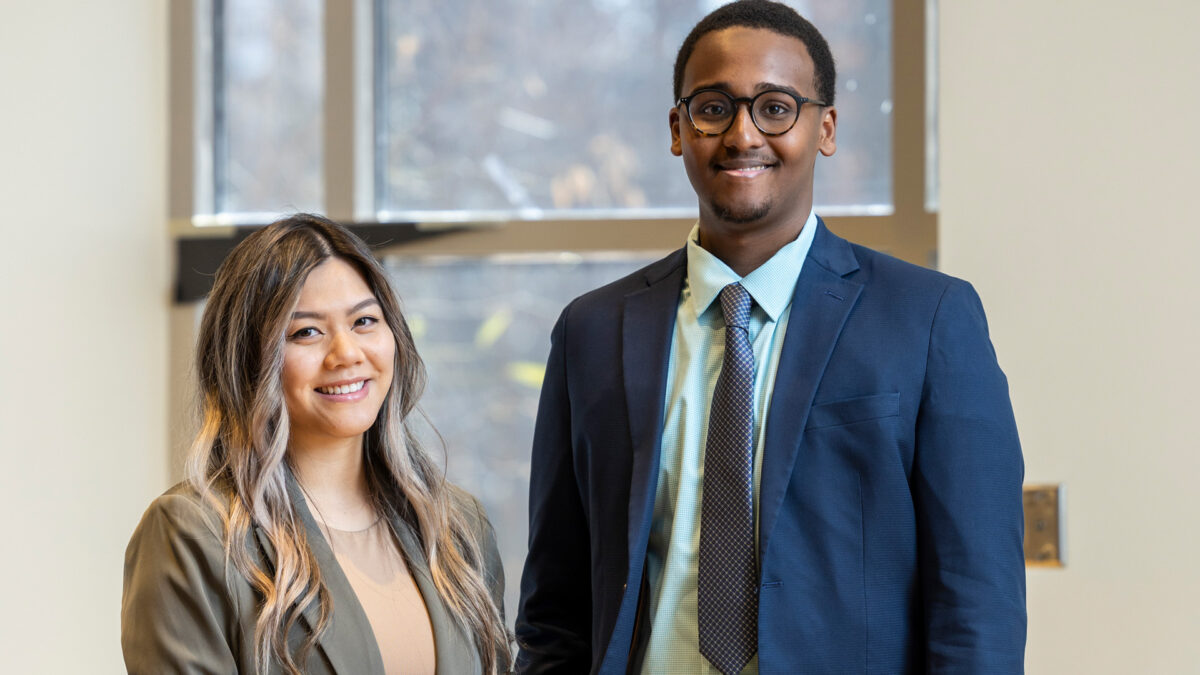
Open to all George Mason students, the Scholarship for Unpaid Internships provides financial support to ensure access to career opportunities.
By Amanda Milewski
In the current unpredictable and ever-changing job market, where even entry-level positions require experience, an internship can make all the difference. But what happens if a lack of financial support prevents a student from accepting a valuable internship that is unpaid, as many often are?
Thankfully, University Career Services (UCS) has a safety net in the way of its Scholarship for Unpaid Internships, which provides funding for students who would be unable to participate in an internship in their chosen field without it. Students can receive up to $1,000 during the fall and spring semesters and up to $3,000 during the summer term if they demonstrate financial hardship and are currently enrolled, degree-seeking students with a minimum 2.0 GPA.
“For some of these students, their internship may convert to a full-time position,” said Rebekah Truog, office manager, University Career Services. However, “having these internship experiences is important for students’ career goals, regardless of whether it leads to a job,” Truog continued. “Employers want to see experience on a resume, and these internships can provide that.”
Invaluable Experience
Julia Decker, a master of social work (MSW) student who is on track to graduate in spring 2026, explained that part of the MSW curriculum is the practicum—or internship. Students in the program must successfully participate in two practicums to graduate, consisting of more than 1,000 unpaid hours of work.
The recipient of a Scholarship for Unpaid Internships, Decker, who is from northern Virginia, completed her first practicum in the spring at VHC Health, a hospital in Arlington. While assigned to the behavioral health and substance use intensive outpatient unit, she “was assimilated into the care team and had the privilege of leading intensive outpatient groups, teaching psychoeducation, leading mindfulness exercises, incorporating new interventions, and more,” she described.
Decker worked under the supervision of a licensed clinical social worker and noted that this type of “critical hands-on learning that extends beyond the classroom,” helps interns progress from social work student to social work professional. “It offered me invaluable experience working directly with the patients, care team, and hospital,” she said.
Preference is given to potential scholarship recipients who are seeking their first internship/career experience. “The scholarship is not major specific,” Truog noted, so there is a wide assortment of internship opportunities available. Many are at nonprofits, community health, social work organizations, and student teaching positions.
“We also are seeing a recent uptick in tech start-ups,” she said.
Meeting a Need
The scholarship program is mainly funded through revenue generated by the UCS career fair as well as donations from their Career Partners Program and donors to the Career Readiness Fund. Scholarship money can be used however the recipient sees fit—tuition, transportation expenses, professional wardrobe needs; there are no restrictions on how the funds are used.
Applicants are required to demonstrate financial need and provide answers to questions relating the internship experience to their career goals, Truog explained. Scholarships are usually awarded in varying amounts to between five and 10 students each semester. She noted that the program has awarded funding to more than 150 students thus far. She likes to remind students of the UCS career readiness equation: Earn a Degree + Gain Experiences + Market Yourself = Career Ready.
Amanda Milewski is a freelance writer.