
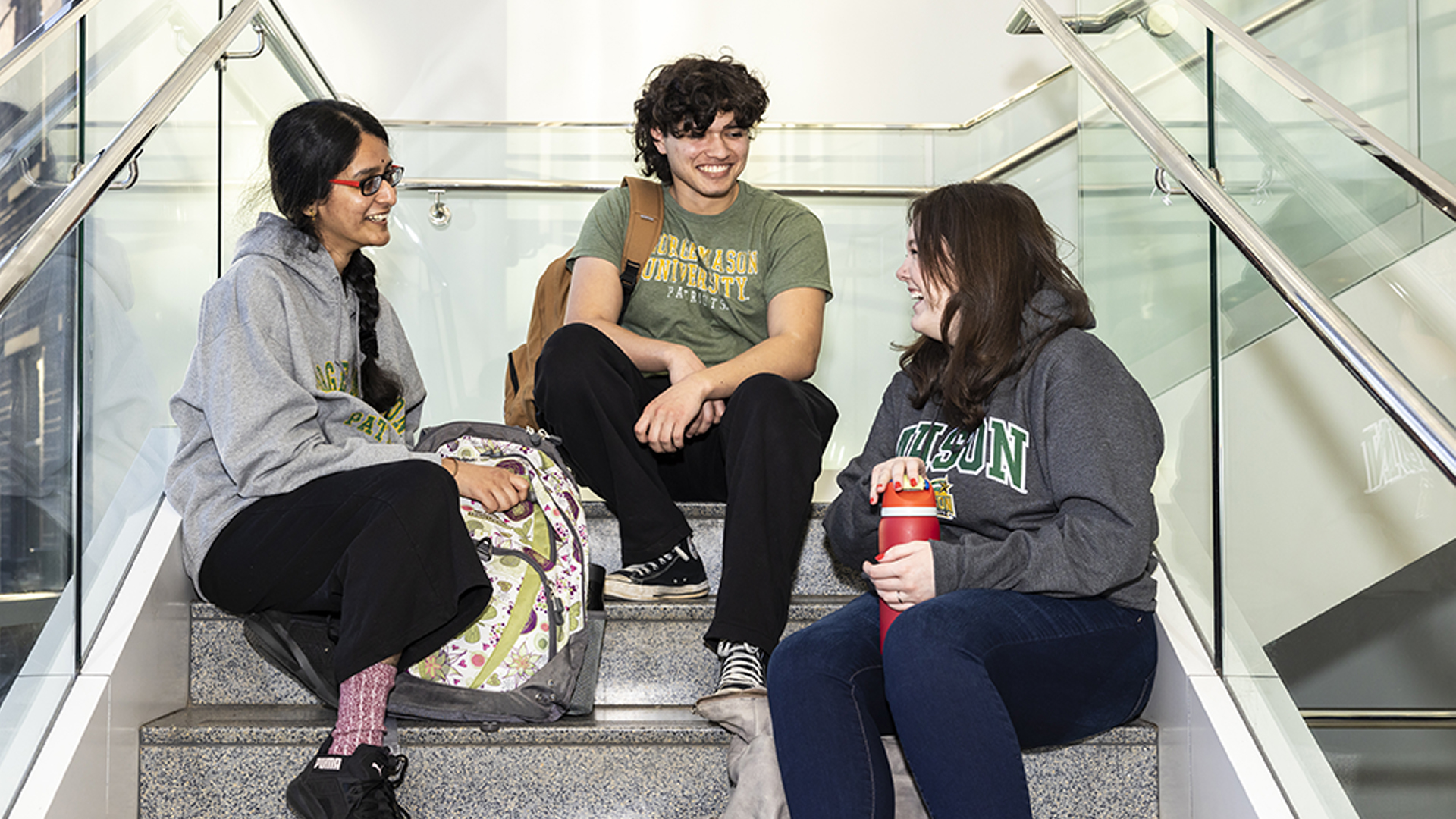
A new coaching program from University Life’s Center for the Advancement of Well-Being allows students to support their peers in developing their strengths.
By Nance Lucas, Lewis Forrest II, and Nancy Donnelly
A new peer coaching program is empowering George Mason University students to unlock their strengths—thanks to a pioneering program from the Center for the Advancement of Well-Being and a transformative $1.5 million grant from the Clifton Foundation.
This fall, an inaugural cohort of 38 undergraduate students begins its learning journey as student peer strengths coaches, guided by a team of 16 faculty, staff, and scholars, known as the Clifton Fellows. The fellows collaborated to lay the foundation for this initiative, shaping every facet of the program and serving as ambassadors for strengths education.
Through the three-credit course UNIV 379 “Strengths Coaching Education,” students will become proficient in the Gallup Organization’s CliftonStrengths Assessment, a self-discovery tool widely used around the world. These paid student coaches will be prepared to help other students discover their unique strengths and how to leverage those in everyday situations. As part of their coursework, student coaches will develop competencies including active listening, communications, leadership presence, and self-awareness—skills needed in today’s workplaces that will make them competitive in the job market.
A High-Impact Learning Experience
Two of the first student coaches—Whitney Cardwell, a sophomore sociology major, and Sydney Carver, a senior majoring in mathematics—see the program as a natural next step in their educational curriculum. “I was interested in the coaching program because it seemed like a great opportunity not only for myself but for the students I’ll be able to help,” Cardwell said. “In addition to learning more about my own strengths, I will be able to help others recognize their strengths, and I thought that was an amazing thing to be a part of!”
Carver noted, “Personal growth is something meaningful to me, and having the opportunity to contribute to a mission involving my peers and community is incredibly valuable to me as well. I hope mostly to be able to share my experience here at Mason as a Black first-generation female in a STEM field. And while this role does not have math at the forefront, it does involve skills-building when contributing as a leader.”
George Mason is uniquely positioned to offer this innovative developmental experience. By leveraging a peer-education model, the program enhances students’ understanding and application of the CliftonStrengths framework while providing career-ready experiences. Research supports the benefits of peer education, showing positive impacts on both competency development and social connection.
Carver is excited to make that connection once the program begins. “My top five strengths are Positivity, Empathy, Winning Others Over, Harmony, and Intellection, which fit well with the responsibilities of this role,” she said. “I’m someone who really leads with my heart for the betterment of others, and to me, that is something I knew would be a major part of student strength coaching and will continue to excite me every step of the way.”
Nance Lucas is executive director of the Center for the Advancement of Well-Being. Lewis Forrest II is assistant vice president for University Life. Nancy Donnelly is a freelance writer.